FAIR USE NOTICE

FAIR USE NOTICE

A BEAR MARKET ECONOMICS BLOG

Occupy Ecology Deeply

This site may contain copyrighted material the use of which has not always been specifically authorized by the copyright owner. We are making such material available in an effort to advance understanding of environmental, political, human rights, economic, democracy, scientific, and social justice issues, etc. we believe this constitutes a ‘fair use’ of any such copyrighted material as provided for in section 107 of the US Copyright Law.

In accordance with Title 17 U.S.C. Section 107, the material on this site is distributed without profit to those who have expressed a prior interest in receiving the included information for research and educational purposes. For more information go to: http://www.law.cornell.edu/uscode/17/107.shtml

If you wish to use copyrighted material from this site for purposes of your own that go beyond ‘fair use’, you must obtain permission from the copyright owner.

FAIR USE NOTICE FAIR USE NOTICE: This page may contain copyrighted material the use of which has not been specifically authorized by the copyright owner. This website distributes this material without profit to those who have expressed a prior interest in receiving the included information for scientific, research and educational purposes. We believe this constitutes a fair use of any such copyrighted material as provided for in 17 U.S.C § 107.

Read more at: http://www.etupdates.com/fair-use-notice/#.UpzWQRL3l5M | ET. Updates

All Blogs licensed under Creative Commons Attribution 3.0

Creative Commons License
This work is licensed under a Creative Commons Attribution 3.0 Unported License.

Saturday, April 13, 2013

Breaking: New Photos, Video of Mayflower Spill and Lake Conway


Breaking: New Photos, Video of Mayflower Spill and Lake Conway

By (about the author)     Permalink      
General News
Become a Fan
  (55 fans)


Perky oil booms placed strategically to save the world. by On Wings of Care


MAYFLOWER, AR.  On April 12, On Wings Of Care (OWOC),  a nonprofit organization dedicated to the protection and preservation of wildlife,  wild habitat,  and natural ecosystems,  flew over ExxonMobil's Pegasus Pipeline spill in Mayflower, AR.

The new images show conditions at the site,  two weeks after the leak began pouring thousands of gallons of crude oil into backyards and backwaters of this neighborhood.


Is this Arkansas in Spring, or a desert wasteland? by On Wings of Care


Now the oil (or more properly, "diluted bitumen") is making its way into nearby Lake Conway. 

On Wings Of Care is a 501(c)(3) charitable organization dedicated to the protection and preservation of wildlife,  wild habitat,  and natural ecosystems.

Founder and President Bonny Schumaker,  Ph.D.,  is retired from 22 years as a scientist at NASA's Jet Propulsion Laboratory.  She's also a former Continental Airlines pilot and has been an FAA flight instructor for over 15 years. 

Combining her skills as pilot and scientist with her passion for wildlife,  Dr. Schumaker has clocked nearly 600 hours of flight time over the Gulf of Mexico,  documenting the status of wildlife,  coastal wetlands,  and offshore waters.

On Wings Of Care's four-minute video flyover is below:


Big manly equipment is dwarfed by the magnitude of the spill ... by On Wings of Care


Only 2 portapotties? Exxon must not be planning a big party. by On Wings of Care


The fragrance of tar sands oil fills the air ... by On Wings of Care


A beautiful day in the neighborhood ... or it should have been! by On Wings of Care


Just another day in paradise... by On Wings of Care


Author's note: Bonny Schumaker of On Wings of Care is piloting the plane, and  after the Mayflower flyover, she is involved with flying 13 rescue dogs to their "fur"-ever homes. I asked her for captions and info on the photos and video when she gets a moment, but I am not sure when we might get that info. I am sure she is a great multitasker, but I don't expect her to be able to fly a plane full of 13 dogs, and text, too!  So, I decided to post the images alone, than  hold them back until I got further info.

And additional info will be posted on http://www.onwingsofcare.org, after all the sweet doggies get to their new homes.

OWOC extends its thanks to Brayton Matthews of FlightlineFirst at New Orleans' Lakefront Airport for joining Bonny on this flight, "so that we could get these photos and videos to you promptly!"

Related articles on Opednews: 
Tar Sands Oil Arkansas #3 (update) (04.12.13) by William Boardman at click here
Tar Sands Oil Arkansas #2 (an update, almost all new)  (04.11.13) by William Boardman at  click here  
Tar Sands Oil Arkansas #1  (04.10.13) by William Boardman at  click here


http://www.merylannbutler.com

Meryl Ann Butler is an artist, author, educator and OpedNews Managing Editor who has been actively engaged in utilizing the arts as stepping-stones toward joy-filled wellbeing for over 25 years. She studied art with Harold Ransom Stevenson in (more...)

Thursday, April 4, 2013

6 Things You Need to Know About the Arkansas Oil Spill


Environment  


For starters, this is not your average crude; but there is a whole lot more you should know.

Photo Credit: Karen McCall/Greenpeace


This article was published in partnership with GlobalPossibilities.org.
By now, you already know that at least 84,000 gallons of crude spilled from an ExxonMobil pipeline, swamping an Arkansas subdivision on Friday, and causing the evacuation of 22 homes. In addition to the loss of wildlife, damage to property, and environmental and human health hazards posed by the spill, it may have implications for the Keystone XL pipeline currently under consideration by the Obama administration.

There is a lot more to the story that's important to understand. Here are six crucial things.

1. Not Your Average Crude

InsideClimate News reported shortly after the spill that an Exxon official confirmed the pipeline was "transporting a heavy form of crude from the Canadian tar sands region." Specifically, it has been identified as Wabasca Heavy, Lisa Song writes, "which is a type of diluted bitumen, or dilbit, from Alberta's tar sands region" although you won't hear any Exxon folks calling it tar sands. 

Dilbit is some seriously nasty stuff. She writes about a previous dilbit spill by Enbridge in Michigan's Kalamazoo River in 2010: 
Dilbit is a mixture of heavy bitumen and diluents--light hydrocarbons used to thin the bitumen so it can flow through pipelines. While most conventional crude oils will float on water, the bitumen began sinking into the river as the diluents evaporated, leaving a sludge of submerged oil that defied traditional cleanup methods. ...
Earlier this month, the EPA ordered Enbridge, Inc., the Canadian company that owns the pipeline, to dredge sunken oil from the riverbed. The cleanup has cost more than $820 million to date and could top $1 billion once the order is carried out.
The Arkansas spill wasn't as big as the Michigan spill and it was farther from main water bodies, but it's still serious business. If you want to know more about how dangerous tar sands/dilbit can be, the Dilbit Disaster is a must-read. 

2. Not Your Average Pipeline

The Pegasus pipeline running more than 850 miles between Patoka, Illinois and Nederland, Texas, is 20 inches in diameter and was built in the 1940s to carry crude from Texas to Illinois. But in 2006 the flow was reversed in order to carry Canadian tar sands to Texas. As Ben Jervey wrote for DeSmog blog, the flow was reversed to "help relieve the tar sands crude bottleneck in Cushing, Oklahoma. (The same reason given by proponents for the construction of Keystone XL.)"

The pipeline was built to carry 65,000 barrels a day, but Exxon was allowed to expand that to 95,000 barrels a day just a few years ago.

All of these facts bring up some basic questions. What effect does a higher capacity have on the pipeline? What effect does reversing the flow have on the pipeline? And what effect does switching from conventional crude to dilbit have on the pipeline, considering it was built to have a much thinner crude flowing through it?

John H. Cushman Jr. wrote for InsideClimate News:
... seven years ago, when Exxon, the pipeline's operator, turned it into a higher-volume line for diluted bitumen from Canada flowing under greater pressure to refineries on the Gulf Coast, federal rules did not require a new permit application or safety reviews, according to federal officials.
"Our regulations don't specify how much product a pipeline carries. There is no regulation if they want to change the type of crude they carry," said Damon Hill, a spokesman for the Pipeline and Hazardous Materials Safety Administration, a part of the Transportation Department. "As far as reversing the flow of a pipeline, it is not a safety issue."
To reverse the line that runs from Patoka, Ill. to Nederland, Tex. required 240,000 man-hours of work on pump stations, valves, bypasses and integrity tests, Exxon said when it opened the line.
But only after the spill occurred did the agency step in with an order, issued Tuesday, that clamps down on the Pegasus pipeline, for example by limiting the pressure at which it may operate once it reopens. Noting that the pipeline's flow was reversed in 2006 so that it could carry Canadian tar sands crude 850 miles from Illinois to Texas, the agency's corrective action order remarked that "a change in the direction of flow can affect the hydraulic and stress demands on the pipeline."
3. Tax Exempt?

Who's footing the bill for the cleanup? The government has an Oil Spill Liability Trust Fund that companies which transport oil must pay into. But, as it turns out, the bitumen that Exxon was transporting in its pipeline isn't oil by government standards. Erin O'Sullivan writes for Oil Change International: 
In a January 2011 memorandum, the IRS determined that to generate revenues for the oil spill trust fund, Congress only intended to tax conventional crude, and not tar sands or other unconventional oils. This exemption remains to this day, even though the United States moves billions of gallons of tar sands crude through its pipeline system every year. The trust fund is liable for tar sands oil spill cleanups without collecting any revenue from tar sands transport. If the fund goes broke, the American taxpayer foots the cleanup bill.
Keep this in mind as Exxon tries to wiggle out of connecting the contents of its pipeline with tar sands.

4. No Media Access 

It feels like BP's Deepwater Horizon disaster all over again when it comes to media access. Lisa Song reported that the command center for cleanup is tightly controlled by Exxon, with even the parking lot off limits and guarded by security. She wrote:
The stakes are high and Exxon is running the show here, with federal agencies so far publicly invisible. The phone number of the command center in Mayflower goes to an ExxonMobil answering service based in Texas, and each day it is Exxon that distributes a unified command press release--which contains the logos of Exxon, Faulkner County and the city of Mayflower--with official updates on the progress of the cleanup. ...
A request for a media tour of the spill site today was turned down by an Exxon spokesperson, who emerged from the command center to speak with a reporter at the gate. All areas being cleaned up so far have also been off limits. There is no central location where members of the media can gather to ask questions.
5. Under Investigation

Exxon may be feeling a little bit of heat as the Pipeline and Hazardous Materials Safety Administration has ordered a corrective action, which puts the broken pipeline under lockdown for the time being (pretty much a no-brainer). Jeannie Nuss reported for the AP that, "the order signed by Jeffrey Wiese, associate administrator for pipeline safety, says 'continued operation of the Pegasus Pipeline would be hazardous to life, property, and the environment.'" 
But that's not all. She writes:
The federal agency's order comes as Arkansas' attorney general promised a state investigation into the cause and impact of the spill and other officials say they plan to ask Exxon to move the Pegasus pipeline to protect drinking water.
"There are many questions and concerns remaining as to the long-term impacts, environmental or otherwise, from this spill," Arkansas Attorney General Dustin McDaniel wrote to ExxonMobil executives Tuesday. He also asked ExxonMobil to preserve records pending his investigation.
6. Effects on Keystone XL

So, how is this going to affect decisions about the Keystone XL pipeline? Those who have been against the pipeline because of its environmental risks have new fodder. Others who were previously in favor or indifferent may have second thoughts, especially considering that the Pegasus pipeline capacity was only about a tenth of what the Keystone XL would carry.

Any pipeline poses risks, but tar sands pipelines pose even more risks than conventional oil. "TransCanada's first Keystone pipeline leaked 12 times in its first 12 months," wrote Sierra Club's Michael Brune. "Because tar sands must be pumped at higher pressures and temperatures than conventional oil, it corrodes pipes faster."

Just days before the Arkansas spill, a coalition of environmental groups, led by the National Wildlife Federation, as well as landowners, and others filed a petition with the Pipeline and Hazardous Materials Safety Administration and the EPA, calling on them to enact stronger safety regulations for pipelines carrying tar sands oil. The petition may well pick up more backers in the spill's aftermath. 

Tara Lohan is a senior editor at AlterNet and editor of the new book Water Matters: Why We Need to Act Now to Save Our Most Critical Resource. You can follow her on Twitter @TaraLohan.

Fracking Debate Reveals Cracks in American Society

Fracking Debate Reveals Cracks in American Society (via http://www.kalev.com)

Story by Robert Gluck Kalev.com Contributor Not being able to resolve issues makes things worse and so it goes with fracking for natural gas. Think of the fracking issue as reflective of our society as a whole. Why? Because the war going on with this issue is similar to other issues. Each side…

Wednesday, April 3, 2013

Exxon Pegasus Oil Spill Shows Why the Keystone XL Issue is So Critical

PolicyMic


Exxon Pegasus Oil Spill Shows Why the Keystone XL Issue is So Critical 

Benjamin Feinblum


exxon, pegasus, oil, spill, shows, why, the, keystone, xl, issue, is, so, critical,


The Keystone XL decision is still underway. While pipeline routes are being adjusted for this project, a similar Exxon pipeline carrying the same oil type has had a major spill in Arkansas. The "Pegasus" pipeline is now releasing thousands of barrels of oil. This example is a regular occurrence. Oil pipelines leak. What would happen if the Keystone XL pipeline sprung a similar leak on it's original route?

By comparing the scale of the Keystone XL project with currently leaking and recently leaking pipelines, considering the route decisions underway for Keystone, and considering the impact of a disaster on proposed routes, the political decisions made to temporarily halt the process while a new route is considered showed leadership and vision by the Obama administration.

Comparing Pipelines

First, lets look at the scale of the Pegasus pipeline that is currently leaking. This is a 90,000 barrel per day capacity pipeline. The expansion of the 20 inch pipeline was completed in 2009. This is an advanced technology pipeline that is supposed to detect leaks. This pipeline was completed just four years ago.

In 2011 Exxon had a similar incident when it's 12-inch Silvertip pipeline leaked 1,000 barrels of oil into the Yellowstone River.

The Keystone XL projected would have a 36-inch pipeline that carries 830,000 barrels per day. The southern leg has been approved and is under construction. The Northern leg is being re-planned to take a different route. The original Keystone pipeline became operational in 2010.

Each pipeline carries oil that is referred to as "Canadian Wabasca heavy crude," or "heavy bitumen crude," which is corrosive.

The Keystone XL pipeline is almost double the size of a currently leaking pipeline and carries more than nine times the quantity of corrosive fuel per day. Keystone XL problems have the potential to release massive quantities more of oil.

Key Route Problems of the Northern Section of Keystone XL

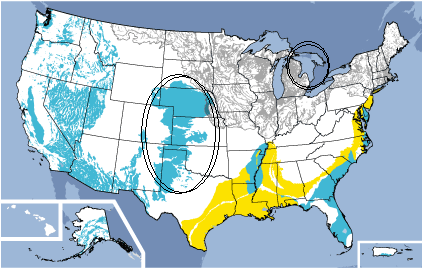
The Northern leg proposal was to take the pipeline through the Ogallala Aquifer, which is one of the largest sources of fresh water in the world. Not only does the aquifer supply water for 2.3 million people, but 30% of all irrigation water for America's farmland comes from this single source, which crosses six states.


Ogallala Aquifer Map

For national context see the circled region:

National Ogallala Aquifer Map


The proposed routes and alternatives have begun to go around the Nebraska Sandhills, which is very sensitive environmental area, but continue to cut straight through the water supply.

Water Supply and Keystone XL

Some reports describe how TransCanada focused it's rerouting on going around property of landowners who most vocally opposed the pipeline. The rerouting does skirt the sandhills, but does not go around the critically important fresh water supply.

TransCanada posted a map of the proposed northern leg. Notice in this map the rust colored line showing the Keystone route already in operation since 2010. Planners of this route knew to go completely around the Ogallala Aquifer and over thicker soil that would not allow oil could to leak through into ground water. Here's TransCanada's own map image.

Keystone pipeline images

Heavy bitumen crude is extremely difficult to clean up during an accident because it sinks.  Skimmers are able to collect other forms of oil on the surface. Now, imagine this form of crude spilled in an underground water source that reaches six states and irrigates our farms. Watch this video from the Pegasus spill to see how hard this is to clean up, above ground, when we can reach it by hand.


Special Conditions of Northern Leg Make Matters Worse 

Not only did TransCanada apply for a route through one of the largest fresh water supplies in the world, but it applied for using thinner pipeline, operating at higher pressure than normal, through a seismic zone that had a 4.3 magnitude earthquake as recently as 2002.

A study was released, which said that the pipeline would have "limited adverse environmental impacts." The New York Times dug deeper and learned that the producer of the study, a company called Cardno Entrix, in it's own marketing materials describes TransCanada as a major client.

The Politics

Republicans have pushed to get this through as quickly as possible. In the 2012 presidential election, Mitt Romney promised that on his first day in office he'd approve the pipeline with it's initial design.

President Obama approved the southern portion and asked for a rerouting of the northern portion around critical areas.

Here is video of President Obama as he fast tracked the Southern portion of the Keystone XL. He mentions the Republican Governor of Nebraska who was concerned about the route of the pipeline.


We can't rush to major decisions like this out of political expediency. These decisions have major and lasting consequences. Imagine if the breadbasket of the United States all the sudden had toxic water rushing through it's irrigation systems. What impact could that have nationwide?

Remember The BP Oil Spill?

The 2011 BP Gulf oil spill was the largest U.S. environmental disaster since the dust bowl during the Great Depression.


NASA satellite footage shows a spill so big you can see if from space.


When the BP spill happened they used massive amounts of chemical dispersant's, that are toxic themselves, to clean up the oil. Seafood was tested for hydrocarbons (oil) but not tested for Corexit and other chemicals used in the cleanup.

The decisions we make today determine the outcomes we face in the future, and president Obama was right to delay the proposed Keystone project.

Sunday, March 31, 2013

Exxon Confirms 80,000-Gallon Spill Contains Canadian Tar Sands Oil


Environment  


The 20-inch Pegasus pipeline was carrying Wabasca Heavy crude from western Canada when it ruptured.

 
Location of Mayflower, Ark. and nearby water sources. (Source: Google maps)
 
 
The story first appeared on InsideClimate News.

A pipeline that ruptured and leaked at least 80,000 gallons of oil into central Arkansas on Friday was transporting a heavy form of crude from the Canadian tar sands region, ExxonMobil told InsideClimate News.

Local police said the line gushed oil for 45 minutes before being stopped,according to media reports.

Crude oil ran through a subdivision of Mayflower, Ark., about 20 miles north of Little Rock. Twenty-two homes were evacuated, but no one was hospitalized, Exxon spokesman Charlie Engelmann said on Saturday.

In an interview with InsideClimate News, Faulkner County Judge Allen Dodson said emergency crews prevented the oil from entering waterways. The judge issued an emergency declaration following the spill and is involved in coordinating clean-up efforts among federal, state and local agencies and Exxon.
The 20-inch Pegasus pipeline runs 858 miles from Patoka, Ill. to Nederland, Texas. Engelmann said the line was carrying Wabasca Heavy crude from western Canada when it ruptured.

Wabasca Heavy is a type of diluted bitumen, or dilbit, from Alberta's tar sands region, according to the Canadian Crude Quality Monitoring Program, an industry source that provides data on different types of Canadian oil.
Because dilbit contains bitumen—a type of crude oil that's heavier than most conventional crude oil—it can be harder to clean up when it spills into water.
A2010 spill in Michigan, which released a million gallons of dilbit in the Kalamazoo River and has cost pipeline operator Enbridge more than $820 million, continues to challenge scientists and regulators as they work on removing submerged oil from the riverbed.

Dodson said emergency crews led a "monumentally successful" effort to prevent the Exxon spill from entering nearby Lake Conway, a popular recreational area. First responders set up earthen dams to contain the flow of oil, he said, and crews are working to shore up the protections as rains continue to fall and complicate the cleanup operations.

The size of the spill remains unclear. Dodson said the Environmental Protection Agency has estimated the spill at 84,000 gallons. The EPA and the Arkansas Department of Emergency Management did not return calls for comment.
According to a Saturday afternoon press release from Exxon, 189,000 gallons of oil and water have been recovered from the site so far, and it is prepared to clean up more than twice that amount.

Exxon's release said the company is "staging a response for over 10,000 barrels [420,000 gallons] to be conservative."

"They're absolutely going above and beyond" what's required, Dodson said. He praised Exxon, local, state and federal agencies for their "amazingly fast response." More than ten agencies responded to the spill within the hour, he said, and "everything fit together perfectly. It was such an efficient response."
According to Exxon, crews have deployed 2,000 feet of boom and 15 vacuum trucks. Dodson said the EPA and Exxon's contractor CTEH are monitoring air quality.

According to Exxon, crews have deployed 2,000 feet of boom and 15 vacuum trucks. Dodson said the EPA and Exxon's contractor CTEH are monitoring air quality.

The spill comes at an inopportune time for the industry, as it lobbies hard for approval of the controversial Keystone XL oil sands pipeline that would carry Canadian dilbit from the tar sand region to Texas refineries on the Gulf Coast. The Obama administration must approve or reject the project because it crosses an international border. Last week, a train hauling Canadian oil derailed and leaked 30,000 gallons of crude in western Minnesota.

Lisa Song joined InsideClimate News in January 2011, where she reports on oil sands, pipeline safety and natural gas drilling. She helped write "The Dilbit Disaster" series, which was a finalist in the 2012 Scripps Howard Awards for Environmental Reporting and an honorable mention in the 2012 John B. Oakes Award for Distinguished Environmental Journalism.

Sunday, March 3, 2013

The Keystone XL Pipeline Is an Eco-Threat -- Why Doesn't the State Department Think So?


  Environment  


The State Department's analysis is not only inaccurate but also incredibly cynical.


Photo Credit: AFP

This article was published in partnership with  GlobalPossibilities.org.

You know the news is going to be bad when they bury it at 4pm on a Friday. We dealt with this for eight years during the Bush administration. I never thought we'd be doing it again under John Kerry's State Department.

The State Department's analysis of the Keystone XL pipeline proposal acknowledges that tar sands crude is 17 percent more greenhouse gas intensive than conventional oil. But State says that the overall environmental impacts of the pipeline are limited because, according to their analysis, the oil would be mined and drilled anyway. That's not accurate. Currently, 1.8 million barrels of oil per day are being produced in the tar sands. Permits have already been issued that would allow that extraction to expand to 5 million barrels of oil per day, and the oil industry would like to go even higher. But the oil industry is the first to admit that it needs new pipeline capacity before it can expand:
"When I talk to producers in Alberta, as long as Keystone XL goes ahead, they view that there's pretty sufficient takeaway capacity to get us to late in the next decade."  --Alex Pourbaix, president of energy and oil pipelines, Transcanada
"All of the crude oil export pipelines are pretty much full, running at maximum capacity... And we're not likely to see any meaningful capacity added to these networks until the end of the year."  --Vern Yu, VP of business development and market development, Enbridge, Inc.
So the State Department's analysis is not only inaccurate but also incredibly cynical. By this same logic, why would anyone in North America stop new coal plants from being built, if the coal would just be burned in China and India anyway? Why would we try to replace fracked gas or mountaintop-removal coal with solar and wind, if we're powerless as a country to lead the world to a clean energy economy? This is shockingly defeatist thinking from a bureaucracy that is now led by someone who has been a proven and courageous champion of the climate throughout his career.   

I spent this morning on a press conference with Mayor Michael Bloomberg discussing how we've succeeded in securing the retirement of 142 coal plants over the past couple of years. Although we've begun to see a clean energy turnaround outside the Beltway, we're still looking for a real sign of strong leadership inside Washington, D.C. Instead, we keep hearing about the inevitability of fossil fuels: All the oil will be burned, no matter how extreme; coal and natural gas should be mined, drilled and fracked, then exported if necessary. Too often, we even hear these tired arguments from climate champions who should know better.  

President Obama needs to reconcile his soaring oratory on climate with strong action to turn away from dirty fuels like tar sands oil. Today, the State Department made the president's job much more difficult. But it's still not too late to stop this pipeline. We have until mid-April to speak out and show the president that there is a national movement demanding he keep his climate promises. Send your message to the administration today. 

10 Stunning Things You Should Know About the Environmental Movement -- 'A Fierce Green Fire' Film Inspires


Environment 


You won't be able to go back to business-as-usual after seeing this hell-raising documentary.


This article was published in partnership with GlobalPossibilities.org.

With runaway global warming threatening to annihilate climate stability and perhaps life on Earth as we know it, there's no bigger issue on humanity's crowded docket and no better time to catch up on the history of the environmental movement. So let's give thanks that writer, producer and director Mark Kitchell's A Fierce Green Fire has arrived to exhaustively school us all. Especially since the Obama administration has gone long on rhetoric but short on activism, and practically begged to be pushed into action by the American people.

"The main lesson of A Fierce Green Fire is the importance of bottom-up movements to force political action and change at the top," Kitchell, director of the Oscar-nominated Berkeley in the Sixties, told me. "Although the environmental movement put on the largest demonstration ever on the original Earth Day in 1970, it was never all that big on taking to the streets. So I’m pleased that the Sierra Club is endorsing getting arrested, and environmental organizations are forming an alliance against the Keystone XL pipeline. The time has come for nonviolent civil disobedience. This is what we need, and we need more of it."

And sooner rather than later, given the popular disconnect that still hovers over the issue, which still suffers from a visibility and comprehension disorder of befuddling proportions given its existential horror. As powerful as the recent Keystone XL protests at the White House proved, they're still paltry compared to the popular momentum needed to get the Obama administration off its ass.

"No, we’re not getting the level of protest we need," Kitchell added. "But part of that is lacking the urgency that a war in Vietnam engenders. Climate change really is the impossible issue, and it’s taking a lot of time and work to get people really focused on protesting it."

Viewers of A Fierce Green Fire -- theatrically released by First Run Features and opening March 1 in New York before going wide across the United States -- likely will feel more galvanized into activism than they were before screening the epic five-act documentary, which is narrated by Robert Redford, Meryl Streep, Isabel Allende, Ashley Judd and Van Jones. Ranging from the turbulent formation and fights of the Sierra Club and Greenpeace to the toxic madness of Love Canal and costly Amazon sacrifice of Chico Mendes, and of course culminating in the mind-wiping dystopia of apocalyptic climate change, A Fierce Green Fire frontloads more than a century's worth of environmental madness and mobilization into a documentary demanding even more activism and answers. It's very hard to walk away from it wanting to go back to business-as-usual.
"We were trying to bring together all the strands of environmentalism, create a grand synthesis and capture the arc of the movement," Kitchell explained. "What struck me was the evolution from local, specific issues to global resource crises. It’s not just climate change, but forests, water, soils, oceans, salinization, agriculture, equity and justice -- and the really big ones like loss of biodiversity and how to put our civilization on a sustainable path to balance with nature. It has been hard for the environmental movement to deal with problems so huge and beyond our ability to solve. Bill McKibbentalks about this in Act Five: 

'Climate change is too big an issue for the environmental movement to take on.' Of course, he proceeds to start an organization, 350.org, to do just that. Maybe that’s what those who consider themselves environmentalists should pass along to younger generations: An appreciation of how big the battle has become, as well as a sense of possibility and hope that comes from succeeding against all odds on earlier issues."

Despite those odds, mammoth progress has been made, said Kitchell. There are a multitude of solutions and changes that have been accomplished during the environmental movement's extensive history of hell-raising. It doesn't take more than a cursory glance around our warming Earth to find citizens engaged in beating back the ravages of environmental devastation.  

"I could point to all sorts of signs that things are changing," he said. "Forty years after photovoltaics first emerged, they're finally showing up in big arrays around California. I love what is happening in Germany, which is not only getting off of fossil and nuclear fuels, but doing distributed generation -- quite literally, power to the people. California and lots of other places are moving toward zero waste. There’s a long list of chemicals and synthetic substances that have been banned one after another."

That said, we're still in a race against time, added Kitchell. Global warming is an exponential, existential nightmare, and it's quickly outpacing our comparatively sluggish efforts at righting the many wrongs of our unsustainable production and consumption, which have seemingly proceeded at light-speed since the Industrial Revolution. If we don't get our earthly priorities straight by the middle of this century, all of our significant advances might not make the slightest bit of difference in the final analysis. 

"The smart people I know who are really thinking about this think that 2050 or so is the nadir, when things get really bad," Kitchell told me. "By 2100, they think we are turning the corner. Depending on how bad it gets -- climate, resource depletion, economic and social collapse and instability -- population and carrying capacity may drop, perhaps drastically. We don’t know and we won’t be around to find out. Hell of a way to run a planet, and a movement. This is new territory."
For those new to the expansive territories of environmental activism, here's a list of 10 stunning things the movement has faced, fought or said in its substantial history and battles.

1. IRS Stands For Irrational Resource Sellouts

Founded in 1892 by John Muir, the Sierra Club, which commands A Fierce Green Fire's first act, is the oldest, largest and most influential grassroots environmental organization in history. By the '60s, however, it had become a pernicious disseminator of "propaganda," according to the IRS, which revoked the Sierra Club's charitable status as pathetic payback for a series of popular protests against dams that would flood the Grand Canyon. It's but one birth pang of many that A Fierce Green Fire uncovers in the Sierra Club's outstanding history.

"It has been too conservative or made bad choices at some points," Kitchell admitted. "But it has survived and thrived. What stands out for me is the democratic nature of the club: It is membership-driven and chapter-based. And I’m really pleased to see the Sierra Club’s evolution under a new generation: Executive director Michael Brune is showing up at Keystone XL protests and taking a lead in a powerful alliance. I’m really jazzed about Beyond Coal’s success and its successor campaign, Beyond Oil. Talk about the main event! I think it’s going to be the most important campaign of the next decade or two."

2. Make Way For Earth National Park (Again)

Much of A Fierce Green Fire's act on Sierra Club focuses on its controversial former leader David Brower, who served as its first executive director from 1952-1969, before being ousted in a dispute over nuclear power, which he opposed. But despite many militant opinions, it is perhaps his polarizing conception of Earth National Park -- in which "all nations...unite against the one real common enemy: rampant technology" -- that may prove most prescient.
"Sure," said Kitchell, when asked if Earth National Park's time has finally come. "I work in a national park, the Presidio. I think the concept has grown enough that we might be able to make the whole world a national park. But Brower was obviously using the idea rhetorically or ontologically, trying to shift consciousness. When I look at where the movement is heading today, I see a few trends: restoration, adaptation and amelioration of climate impacts."

3. Martin Litton, Badass

He may be 87, but the pioneering environmentalist, who teamed up with Brower to fight dam-building, is no fragile flower -- and he doesn't want the environmental movement to be either. Environmentalists should "be unreasonable," he argues in A Fierce Green Fire. They should have "hatred in [their] heart[s]" for polluters and ravagers, and they should tell a society that befouls the environment to "drop dead."

4. Spaceship Earth, Cleared For Takeoff

Despite Brower's aforementioned hatred of technology, one of the environmental movement's most notable evolutionary moments came in the '60s and '70s, when it embraced science and tools to effect local and global change. From Stewart Brand's countercultural DIY manual Whole Earth Catalog to the organic pioneer New Alchemy Instituteand beyond, hacking Earth became a hippie ideal that has evolved well into our still-new millennium.

"I like Bucky Fuller’s idea that we have to guide Spaceship Earth," Kitchell told me, "as well the idea that we are Gaia, the animating force that will keep this planet habitable. Remember Stewart Brand’s motto in the Whole Earth Catalog? 'We are as gods, and might as well get good at it.' Well, in a piece of the A Fierce Green Fire that was edited out late, Stewart talked about how it has changed to, 'We are as gods -- and have to get good at it.'"

5. Richard Nixon, Environmental Activist? Mindfuck! 

Believe it or not, it is the disgraced Nixon's administration that proposed and formed the Environmental Protection Agency, and supported a variety of world-changing green laws. But the history books don't tell the whole story, said Kitchell, whose documentary nevertheless gives Tricky Dick the time of day. "Nixon was trying to outflank Edmund Muskie, a real environmentalist. More important was the bipartisan group of senators who sponsored and passed the golden era of environmental legislation. They overrode Nixon’s veto more than once. The Dirty Dozen campaign, launched by the Earth Day folks, unseated some powerful congressmen in 1972, and after that everyone was an environmentalist."

6. Love Canal, Mutant Factory

One astounding act of A Fierce Green Fire is dedicated to this infamous New York neighborhood built atop an Occidental Petroleum toxic-waste dump. The entire segment beggars belief, from its alarming genetic and physical deformities to its naked corporate corruption. But its most stunning achievement is its grassroots uprising, led by the legendary Lois Gibbs, who galvanized neighbors and the nation alike. But most egregious is the government's claim that Gibbs' personal investigations, later correlated by pretty much everyone, was comprised of what she recalled as "useless housewife data." And that EPA relocation advisory blocked by Carter? Mindfuck, the Sequel.

7. "Apartheid American Style!"

Lost in the toxic soup of environmental and corporate pollution are the disproportionate numbers of people of color condemned to sickness and death. That is, until the conscientious pioneer Robert Bullard arrived in the '80s to ignite the environmental justice movement as we know it. But the author of Dumping in Dixie and Toxic Waste and Race understands that true environmentalism is both colorful and colorblind. “There’s no Hispanic air," he argues in A Fierce Green Fire. "There’s no African-American air. There’s air! If you breathe air -- and most people I know do breathe air -- then I would consider you an environmentalist.”

8. The Coming of Environmental Terrorism?

With global resource wars already well underway, enviroterrorism seems like it's going to become, as the popular slang goes, a thing. But it has proven polarizing on either side of the environmental movement. On one side you have insurgents like Greenpeace influential and Sea Shepherd Conservation Society founder Paul Watson, who as A Fierce Green Fire graphically illustrates isn't shy about getting physical for his environmental beliefs. This philosophy is corroborated somewhat in the documentary by Greenpeace co-founder Bob "Mind Bombs" Hunter, who notes that "we're insane" for killing sperm whales for their lubricant, which we use to make better inter-continental ballistic missiles to kill each other. But despite the fact that Watson, currently fighting extradition notices from Costa Rica and Japan, has been battling whalers worldwide, Kitchell seems confident that the enviroterrorism label won't stick to him.
"Not a chance," he said. "Every time they go after Paul Watson, he just gets bigger."

But Kitchell stops short of endorsing more radical environmentalists, whose records speak for themselves.

"I had to stop using terms like radical ecology or deep ecology, in favor of alternative ecology movements," he added. "Radicals means Earth First, and much as I love and respect them, look how much they accomplished."

9. Chico Mendes, Amazonian Canary

One moving act of A Fierce Green Fire is dedicated to this indefatigable grassroots environmentalist, whose leadership of Brazilian rubbertappers seeking to save the Amazon rainforest from rapacious development cost him his life. It is one of the documentary's most bittersweet moments, given that the Amazon -- which comprises over half of Earth's remaining rainforests and stores 10 billion tons of carbon, more than annual global emissions from fossil fuel combustion -- is in danger of losing its total cover by 2100. Be afraid, very afraid.

"Thomas Lovejoy, who has studied the Amazon and how it unravels the most closely and the longest, talks about global forestry compacts and deals, and regulating carbon and nitrogen. He's saying, it’s a new day. And who knows? It might even make us get along! There have been and will be parts of the Amazon that are lost. The rain machine will stutter and maybe halt. But a third of the Amazon is under formal protection. That’s impressive and amazing, better than we’ve done in America."

"So it will be a world of islands, biologically and otherwise," Kitchell concluded. "Find a good place to take refuge, go local, consume less, dematerialize and cyberneticize. And restore the land."

10. Global Warming Is Truly Bipartisan

One thing above all becomes crystal clear while watching A Fierce Green Fire: When it comes to climate change, it is both Democrats and Republicans who have screwed us all. The documentary's final act on the greatest environmental threat facing any generation of American history has nothing good to say about either party, from Nixon to Carter to Reagan to Clinton to Bush to Obama.

Which is why it's more important than ever for citizens of any political persuasion to take up the charge and force the American government to get it in gear before global warming turns into a full-fledged apocalypse rendering the Earth uninhabitable. And the Keystone XL pipeline -- whose cargo means game over for climate stability, as NASA atmospheric physicist James Hansen so incisively argued last year -- is the flashpoint for that fight, which needs to heat up, not cool down.

"It is a protest against the Obama administration, meant very deliberately to put pressure on them to do the right thing," Kitchell said. "And it seems to be working. I don’t hear much talk of an 'all-of-the-above' energy policy now. But part of the problem with the environmental movement is it doesn’t have the power to swing elections and instill fear and discipline in politicians. You could say that of most mass movements, though."

"I’ve been trying in this film, and the process of making it, to look at the bigger picture of where environmentalism is going and what it means," he added. "I think it’s about civilizational transformation, an idea I got from Paul Hawken. It’s the next big transition after the Industrial Revolution, and it’s about reinventing the way we make and do everything to bring our industrial society into sustainable balance with the natural world on which we depend for survival. That’s why the subtitle of the film is The Battle For a Living Planet.”

Scott Thill runs the online mag Morphizm.com. His writing has appeared on Salon, XLR8R, All Music Guide, Wired and others.